Let’s Buy Spirit Explained: From Viral Campaign to a New Airline.
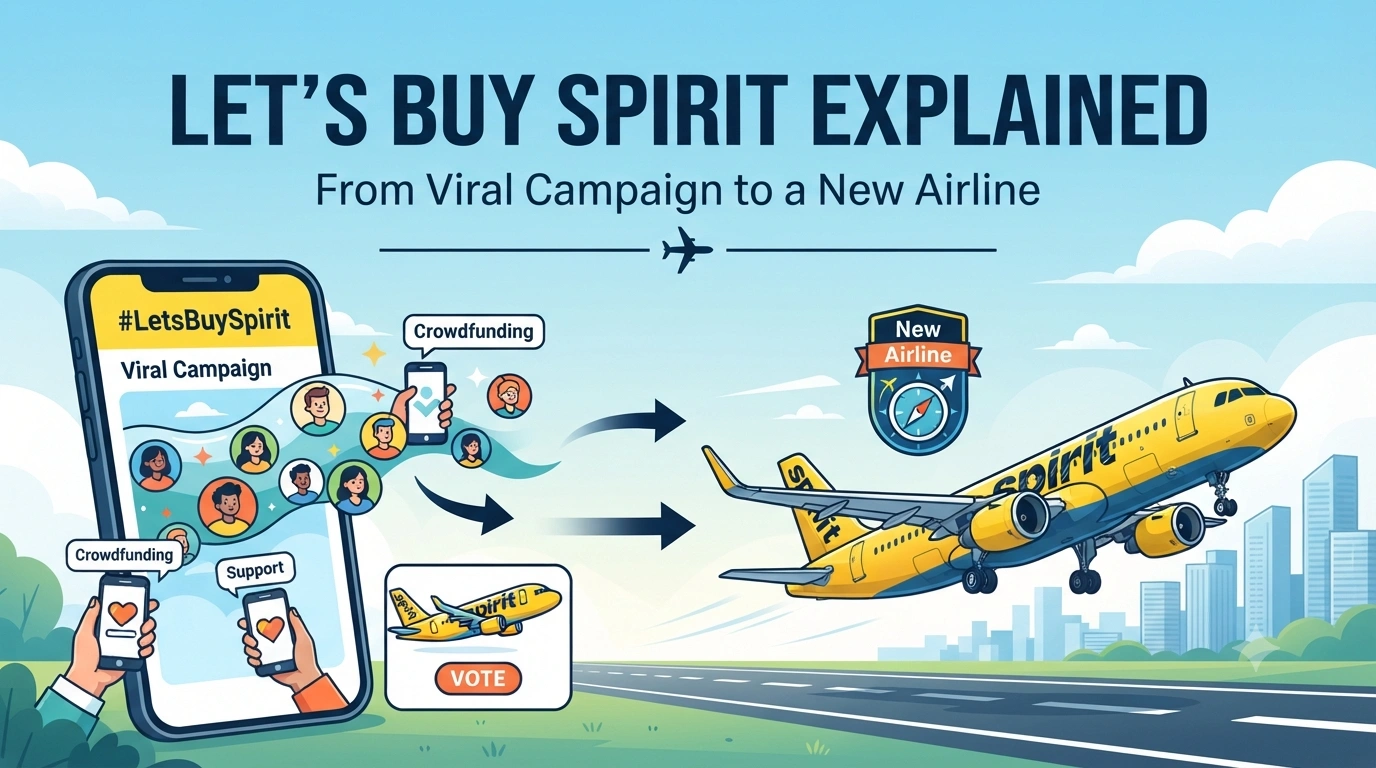
The phrase Let’s Buy Spirit became one of the most unexpected aviation stories of 2026. What began as a social-media idea quickly attracted hundreds of thousands of people who expressed interest in helping revive Spirit Airlines through a community-backed ownership model.
The original concept was simple: instead of allowing an airline to disappear, could ordinary travelers pool their resources and buy it?
That idea came from Hunter Peterson, a content creator and voice actor, shortly after Spirit Airlines stopped operating in May 2026. The campaign rapidly gained attention online, with millions of dollars in non-binding pledges reported by the organizers and media outlets. Importantly, those pledges were expressions of interest rather than money collected for an airline acquisition.
Since then, the project has evolved. The team ultimately moved away from purchasing Spirit’s remaining assets and began working on a new airline concept. Current information associated with the project points toward First Jet Air, a proposed airline built from the ground up rather than a simple revival of the original Spirit Airlines.
So, what exactly was Let’s Buy Spirit, how did it become popular, and what happened to the Spirit 2.0 idea?
This guide explains the story, the crowdfunding concept, the proposed community ownership model, the shift toward First Jet Air, and what readers should understand before treating online pledges or investment announcements as completed transactions.
Quick Answer: What Is Let’s Buy Spirit?
Let’s Buy Spirit was a grassroots online campaign launched after Spirit Airlines ceased operations in May 2026. Its original goal was to explore whether travelers and ordinary members of the public could collectively support the purchase and revival of Spirit Airlines.
The campaign was started by Hunter Peterson and became widely known through TikTok and other social platforms. Early reports showed rapidly increasing pledge totals, but the campaign emphasized that these were non-binding pledges, not completed investments.
The concept later changed.
After the effort did not result in the acquisition of Spirit Airlines’ assets, the project shifted toward building a new airline. First Jet Air now describes itself as the next stage of that idea, with a focus on creating an airline intended to be owned or meaningfully connected to the people who fly it.
Key facts at a glance
| Topic | What it means |
|---|---|
| Original project | Let’s Buy Spirit |
| Main figure | Hunter Peterson |
| Original idea | Publicly supported acquisition of Spirit |
| Launch period | May 2026 |
| Initial funding mechanism | Non-binding public pledges |
| Spirit acquisition | Not completed |
| Later direction | Build a new airline |
| Current associated name | First Jet Air |
| Original community concept | Community-backed airline ownership |
| Current status | Developing a new airline concept |
What Was Let’s Buy Spirit?
Let’s Buy Spirit was an online movement built around an unusual question: could ordinary travelers collectively help purchase an airline?
The idea appeared shortly after Spirit Airlines announced that it would stop operating. Rather than viewing the shutdown as the end of the brand, Peterson suggested that the public could potentially step in.
His proposal attracted attention because airline ownership is normally associated with corporations, institutional investors, private equity firms and wealthy individuals. The Let’s Buy Spirit concept presented a very different possibility: a community-supported airline.
The initial campaign therefore combined social media, crowdfunding-style pledges and a proposed ownership structure.
It was not, however, the same thing as successfully purchasing Spirit Airlines.
Reports published during the campaign made clear that the numbers displayed represented pledges or expressions of intent. They should not be interpreted as cash sitting in a bank account or as proof that the campaign had acquired the airline.
That distinction remains important when discussing Let’s Buy Spirit today.
Why Did the Campaign Start?
Spirit Airlines’ shutdown created a rare opening for a completely different conversation about airline ownership.
For years, Spirit had been associated with ultra-low-cost air travel in the United States. Its business model focused on offering low base fares while charging separately for many optional services.
When the airline ceased operations, the event generated substantial discussion among travelers and aviation enthusiasts.
Peterson responded by proposing that the public could collectively attempt to bring the airline back.
The idea was partly built around the logic that an enormous number of travelers spending relatively small amounts could theoretically create a much larger pool of capital.
Instead of asking one billionaire or major corporation to purchase an airline, the campaign asked whether thousands or even hundreds of thousands of ordinary people could participate.
That concept proved highly shareable on social media.
Who Started Let’s Buy Spirit?
Hunter Peterson became the public face of the Let’s Buy Spirit campaign.
Before the movement appeared, Peterson was known for work as a voice actor and digital creator. He had also created airline-related content, including a challenge involving extended travel on Spirit Airlines.
His background in digital content helped the idea spread quickly.
A short social-media concept can reach an enormous audience when it combines humor, a recognizable brand and a simple question. Let’s Buy Spirit had all three.
The campaign also benefited from a highly recognizable airline brand. Even people who had never followed Spirit Airlines closely could immediately understand the basic concept of trying to bring back a familiar carrier.
How Did the Pledge Campaign Work?
The original campaign did not simply sell shares in Spirit Airlines.
Instead, visitors could indicate how much they would potentially contribute toward the proposed effort.
As interest grew, the reported totals increased dramatically.
Different reports captured different points in the campaign. Early coverage reported tens of millions of dollars in pledges, while later reporting cited more than $200 million in pledged support. The exact figures changed rapidly as more people participated.
The important point is that pledged money was not the same as collected money.
A pledge means someone expressed an intention to contribute under a proposed structure. It does not automatically mean that the person transferred funds or purchased an ownership interest.
This distinction is particularly important when reading headlines that describe large dollar amounts associated with the movement.
Why Did Let’s Buy Spirit Go Viral?
Several factors helped the campaign spread.
1. The idea was easy to understand
“Can we all buy an airline?” is an extremely simple social-media question.
People did not need advanced knowledge of aviation finance to understand the basic proposition.
2. Spirit already had a recognizable brand
Spirit was a major U.S. airline with a large customer base. That gave the campaign an existing audience of travelers who understood the brand.
3. Community ownership was unusual
Most airlines are not structured around direct ownership by ordinary passengers.
The idea therefore created curiosity about what an airline owned by its customers might look like.
4. Social media created momentum
As people shared the idea, more users visited the campaign website and expressed interest.
Reports also said the website experienced significant traffic during the early period.
5. The campaign mixed entertainment with business
The project was not presented like a traditional corporate acquisition announcement.
Its social-media roots made it feel more accessible, which helped the story spread beyond aviation and finance communities.
What Was Spirit 2.0?
Spirit 2.0 became the informal name associated with the proposed revival concept.
The basic vision was not simply to restart the old airline exactly as it had operated.
Instead, supporters discussed creating a new structure that could put more emphasis on community participation and passenger ownership.
One frequently mentioned comparison was the Green Bay Packers ownership model. The Packers are known for their community ownership structure, although an airline would operate under completely different legal, financial and regulatory requirements.
That distinction matters.
A professional sports franchise and an airline have fundamentally different capital needs, safety obligations, regulatory requirements and operating structures.
Therefore, the Packers example was better understood as inspiration for the ownership philosophy, not as a ready-made legal blueprint for operating an airline.
Why Didn’t the Original Plan Happen?
Buying an airline is far more complicated than collecting enough public interest.
An airline acquisition can involve aircraft, airport slots, contracts, employees, technology systems, intellectual property, operating certificates, regulatory approvals, creditors and other assets.
Even if a campaign attracts a large amount of public interest, that does not automatically give it control over an airline’s assets.
The Let’s Buy Spirit campaign ultimately did not acquire Spirit Airlines.
By the summer of 2026, the project had moved away from purchasing Spirit and toward creating a new airline instead. First Jet Air’s own public description says the team decided to build an airline from the ground up after walking away from the Spirit acquisition effort.
That represented a major change in strategy.
From Let’s Buy Spirit to Let’s Build an Airline
The next phase is arguably more interesting than the original viral campaign.
Rather than trying to resurrect Spirit Airlines through an acquisition, the project began developing a new carrier.
Current public information identifies First Jet Air as the organization associated with this new direction. Its public description says the project evolved from the original effort to buy Spirit and now aims to build an airline from the ground up.
Media reporting has also described the broader project as a rebranded “Let’s Build An Airline” initiative.
This means that searches for terms such as:
- Let’s Buy Spirit
- Spirit 2.0
- Spirit 2.0 airline
- Let’s Build an Airline
- First Jet Air
may now refer to different stages of the same broader project.
What Is First Jet Air?
First Jet Air is a proposed airline project that emerged from the Let’s Buy Spirit movement.
Its public messaging emphasizes putting passengers and community participation at the center of the airline’s structure. The company’s LinkedIn profile describes the project as a 2026-founded airline initiative and says the team moved from trying to purchase Spirit to building a new carrier.
The stated philosophy centers on the idea that travelers should have a stronger connection to the airline they use.
That could potentially involve ownership, membership or other forms of customer participation, depending on the final structure.
However, readers should distinguish between a business vision and an operating airline.
Creating an airline requires much more than a brand, website or community.
What Makes Starting an Airline Difficult?
Launching a new airline requires substantial capital and operational planning.
Aircraft
An airline needs access to aircraft through ownership, leasing or another approved arrangement.
Aircraft also require maintenance programs, crews, insurance and operational infrastructure.
Regulatory approval
Commercial aviation is heavily regulated.
A new carrier must satisfy applicable aviation authorities and meet requirements involving safety, operations, personnel, maintenance and financial responsibility.
Airport access
Having an aircraft does not automatically mean an airline can fly wherever it wants.
Airports have gates, slots, schedules, fees and operational restrictions.
Employees
Pilots, flight attendants, mechanics, dispatchers, customer-service teams and other specialists are required to operate a commercial airline.
Technology
Modern airlines depend on reservation systems, payment infrastructure, mobile applications, websites, operational software, customer communications and cybersecurity.
Capital
Fuel, aircraft, maintenance, labor, insurance, airport costs and technology can require significant funding before an airline generates meaningful revenue.
For that reason, public enthusiasm is only one part of the equation.
Are Let’s Buy Spirit Pledges Investments?
Not necessarily.
This is one of the most important points for anyone researching the campaign.
The original pledge system represented expressions of interest. Media reports described the pledges as non-binding rather than completed financial investments.
That means someone who entered a pledge should not automatically assume they owned Spirit Airlines or received shares in a new company.
The later First Jet Air project has a different context, with its public communications referring to investment participation and different investor categories. Its signup material distinguishes between accredited investors, non-accredited investors and people interested in volunteering.
Anyone considering an actual financial investment should therefore read the current offering documents carefully rather than relying on old social-media posts about Let’s Buy Spirit.
What Should Potential Participants Check?
People researching First Jet Air, Spirit 2.0 or any related campaign should verify the current information before providing money or personal details.
Check the current company
Make sure you know whether you are dealing with the original Let’s Buy Spirit campaign, Spirit 2.0, Let’s Build an Airline or First Jet Air.
Names and strategies have changed.
Read the legal documents
Look for official offering documents, subscription agreements, risk disclosures and information explaining what you actually receive.
Separate pledges from investments
A pledge is not necessarily an investment.
Likewise, social-media follower counts do not establish a company’s financial position.
Understand the risks
Airlines are capital-intensive businesses and face fuel-price changes, regulatory requirements, economic cycles, labor costs and operational risks.
Verify the official website
Avoid sending money through unofficial links shared in comments or random social-media posts.
Check what ownership actually means
If an organization describes itself as community-owned, investigate the legal structure.
Ask whether participants receive shares, cooperative membership, voting rights, profit participation or something else.
Is Let’s Buy Spirit Still Buying Spirit Airlines?
Based on current public information, the project is no longer focused on buying Spirit Airlines.
The campaign’s direction changed after the effort to acquire Spirit did not produce the intended transaction. First Jet Air now describes its approach as building a new airline from the ground up.
That is an important distinction for anyone searching for recent information.
The name “Let’s Buy Spirit” still appears online because it became the recognizable name of the original viral movement. However, the underlying business strategy has moved beyond simply purchasing Spirit.
Why the Story Matters for the Airline Industry
The Let’s Buy Spirit story illustrates how social media can turn a business idea into a large public movement within days.
Traditional airline startups usually begin with business plans, investors, aviation professionals and regulatory preparation.
This project began differently.
It started with an online thought experiment and attracted a community before a conventional airline existed.
That sequence is unusual.
It also demonstrates the difference between audience-building and business execution.
A large online audience can help a startup attract attention, potential customers, employees and investors. But aviation still requires regulatory compliance, financing, aircraft, experienced personnel and operational infrastructure.
In other words, viral attention can create an opportunity, but it does not replace the requirements of running an airline.
Frequently Asked Questions
What is Let’s Buy Spirit?
Let’s Buy Spirit was a 2026 online campaign proposing that members of the public could collectively support the purchase and revival of Spirit Airlines. It was launched by Hunter Peterson after Spirit ceased operations.
Did Let’s Buy Spirit actually purchase Spirit Airlines?
No. The campaign did not complete the proposed acquisition. The project later shifted toward building a new airline rather than purchasing Spirit.
What happened to Spirit 2.0?
Spirit 2.0 was the name associated with the proposed revival and community-ownership concept. The project later evolved into a new-airline initiative associated with First Jet Air.
Were the millions of dollars real investments?
The original campaign’s widely reported figures represented non-binding pledges rather than money collected as completed investments.
Who is behind First Jet Air?
First Jet Air identifies itself publicly as the airline project that grew out of the original Let’s Buy Spirit movement. Its public profile lists the company as founded in 2026.
Is First Jet Air the same as Spirit Airlines?
No. First Jet Air is being developed as a new airline rather than simply being the existing Spirit Airlines operating under another name.
Final Takeaways
Let’s Buy Spirit started as an unconventional idea: what if ordinary travelers could collectively help buy and revive a major airline?
The concept spread rapidly after Spirit Airlines stopped operating in May 2026. Public interest produced a large number of reported pledges, but those figures represented expressions of intent rather than completed funding.
The original acquisition effort ultimately did not result in the purchase of Spirit Airlines.
Instead, the project changed direction.
The current story centers on building a new airline, with First Jet Air presenting itself as the next stage of the community-driven aviation concept.
For readers, the most important distinction is between the viral campaign, the Spirit 2.0 concept, and the new-airline project that followed.
Those terms are connected, but they do not describe exactly the same thing.
As the project develops, readers should rely on current company information and formal documents when evaluating ownership, investment opportunities, timelines or airline operations. Social-media pledges and headlines can show public interest, but they should not be treated as proof that an airline acquisition or launch has been completed.