
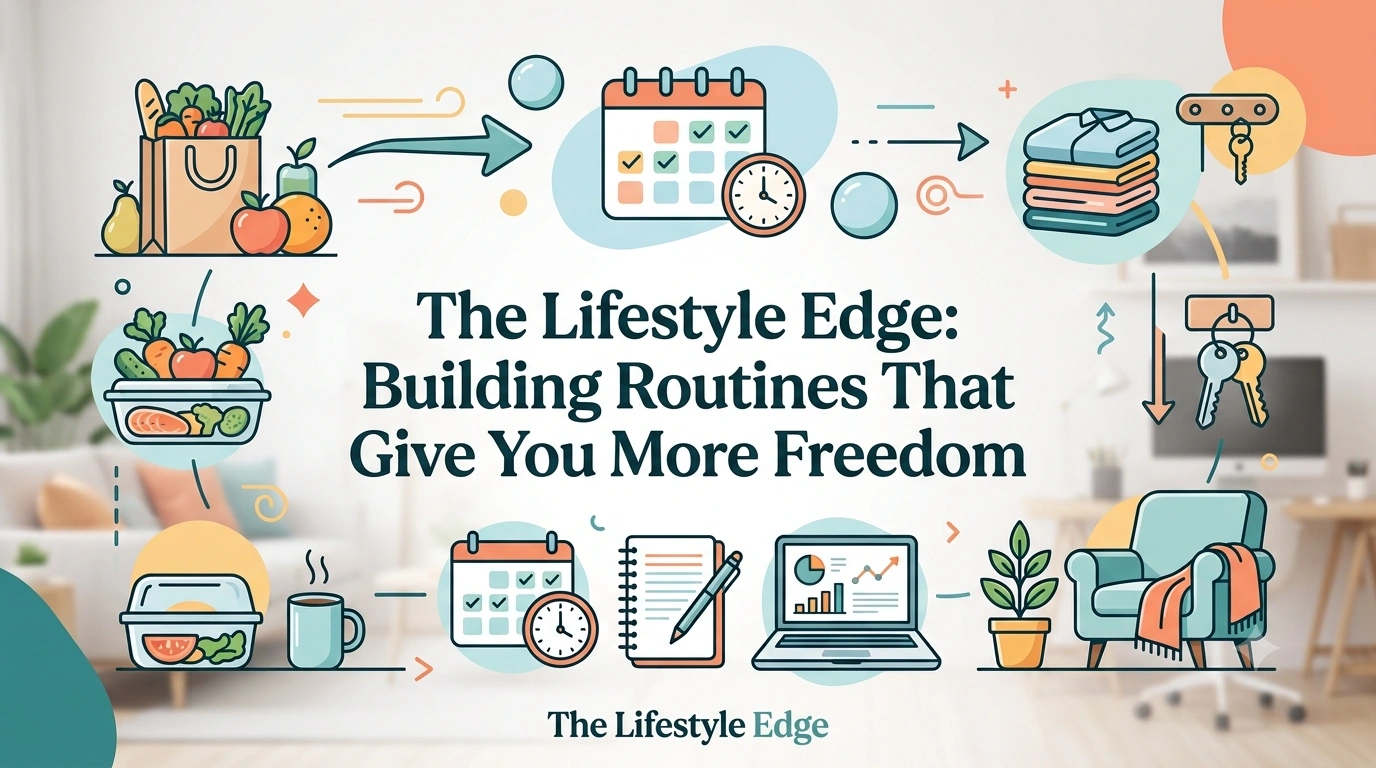
The Lifestyle Edge: Building Routines That Give You More Freedom.
Introduction
A good routine should make life easier, not make every day feel controlled.
The right systems can quietly handle recurring responsibilities so you don’t have to spend the same mental energy on them again and again. Knowing where your essentials are, having a reliable way to manage tasks, and creating space for personal interests can make everyday life feel more manageable.
The Lifestyle Edge is about using practical habits to create that kind of freedom. It isn’t about building a perfect schedule or following a strict productivity philosophy. Instead, it focuses on making small improvements that fit your real circumstances.
In this guide, you’ll discover practical ways to simplify routines, organize your environment, manage attention, reduce unnecessary decisions, and create more room for the things you actually value.
What Is The Lifestyle Edge?
The Lifestyle Edge is the practical advantage you gain when your everyday systems support your priorities instead of creating unnecessary work.
It can come from simple improvements such as:
- Creating reliable routines
- Organizing frequently used items
- Reducing unnecessary decisions
- Protecting focused time
- Simplifying digital information
- Planning recurring responsibilities
- Making room for hobbies and relationships
The objective isn’t to optimize every minute.
It’s to create enough structure that your day doesn’t constantly require reinventing the wheel.
1. Build Routines Around Real Life
A routine is useful only when you can actually follow it.
Before creating one, consider:
- What do I already do consistently?
- What regularly causes problems?
- Which tasks repeat?
- Where do I lose time?
- What would make my day easier?
Start with existing behavior instead of creating an entirely new lifestyle.
2. Turn Repeated Decisions Into Defaults
If you make the same decision frequently, consider creating a default.
Examples include:
- A regular location for keys
- A standard weekly planning time
- A consistent place for documents
- A basic grocery list
- A predictable morning sequence
Defaults don’t remove choice.
They simply save you from making the same small decision repeatedly.
3. Keep Your Routine Flexible
A routine shouldn’t collapse when something unexpected happens.
Build flexibility into it.
Instead of scheduling every minute, identify:
- Fixed commitments
- Important priorities
- Flexible tasks
- Personal time
This gives your day structure without making it unnecessarily rigid.
The Lifestyle Edge at Home
Your physical environment can support your routines when it is organized around how you actually live.
4. Make Frequently Used Items Easy to Reach
Think about the things you use every day.
If something is constantly being taken out and put away, its storage location should be convenient.
Examples include:
- Keys
- Bags
- Chargers
- Work equipment
- Cooking essentials
- Everyday accessories
Convenience makes habits easier to maintain.
5. Create a “Landing Zone”
Choose one place where items go when you enter your home.
It could be a small area for:
- Keys
- Wallet
- Bag
- Sunglasses
- Other everyday essentials
The goal is simple:
Arrive → place items there → find them easily later.
6. Fix the Cause of Clutter
If the same surface becomes messy repeatedly, don’t simply clean it again.
Ask:
Why do these items keep ending up here?
Maybe there is no convenient storage location.
Maybe the existing location is too far away.
Maybe the item is used frequently and needs to be accessible.
Solve the reason behind the clutter.
7. Use a Small Daily Reset
A short reset can keep your environment manageable.
Before ending your day:
- Return frequently used items.
- Clear your main workspace.
- Put away loose materials.
- Review tomorrow’s commitments.
- Prepare one important item.
The process should be short enough to repeat consistently.
The Lifestyle Edge and Time Freedom
Having more free time isn’t always about finding extra hours.
It can also come from reducing unnecessary work.
8. Identify Your Time Leaks
Look for activities that repeatedly consume more time than they deserve.
Examples might include:
- Searching for misplaced items
- Rechecking the same information
- Excessive notifications
- Repeated errands
- Unnecessary meetings
- Overcomplicated planning
Choose one time leak and improve it.
9. Use a “Next Action” System
Large tasks can become easier when you identify the next physical action.
Instead of writing:
“Plan the project.”
Write:
“Open the project notes and list the three main requirements.”
Instead of:
“Clean the room.”
Write:
“Clear the desk.”
Specific actions create a clear starting point.
10. Group Similar Tasks
When practical, group activities that require similar attention.
For example:
Communication
Handle non-urgent messages during selected periods.
Errands
Combine trips where practical.
Administration
Process routine paperwork together.
Planning
Review the upcoming week at one consistent time.
This can reduce unnecessary switching between unrelated activities.
11. Stop Treating Every Task as Urgent
Some tasks can wait.
When something appears, ask:
- Does it have a real deadline?
- Is someone waiting on me?
- What happens if I do it tomorrow?
- Is it more important than my current priority?
A calmer schedule often starts with recognizing what doesn’t require immediate action.
The Lifestyle Edge and Digital Freedom
Your digital environment can either simplify your day or constantly compete for your attention.
12. Review Notifications
Go through the apps and services that send alerts.
Ask:
“Does this genuinely need my attention immediately?”
If not, consider reducing the interruption where possible.
13. Use Clear Digital Categories
Keep important information in predictable locations.
For example:
Work
- Current
- Completed
- Reference
Personal
- Documents
- Travel
- Finance
You don’t need a complex hierarchy.
You need a structure you understand.
14. Create a Single Source of Truth
If you keep the same information in several places, it can become difficult to know which version is current.
For important categories, choose a primary location.
For example:
- One main calendar
- One primary task list
- One location for important documents
This reduces unnecessary checking.
15. Schedule Digital Maintenance
Instead of constantly cleaning digital clutter, review it periodically.
You might check:
- Downloads
- Screenshots
- Old files
- Bookmarks
- Unused applications
- Email subscriptions
Small maintenance sessions can prevent digital clutter from becoming overwhelming.
The Lifestyle Edge and Smarter Spending
Your lifestyle includes the things you buy and maintain.
16. Think About the Life Behind the Purchase
Before purchasing something, ask:
“Will this fit naturally into my life?”
Consider:
- How often you’ll use it
- Where it will be stored
- Whether you already own something similar
- Whether it requires maintenance
- Whether it solves a genuine problem
A useful purchase should fit your actual circumstances.
17. Don’t Let Convenience Create More Work
Some products save time.
Others create additional maintenance.
Before buying something, consider the complete experience:
Purchase → store → use → clean → maintain → replace
This doesn’t mean avoiding convenient products.
It means considering the responsibilities they create.
18. Maintain a Simple Shopping System
Keep one running list for things you genuinely need.
When something runs low, add it.
Before shopping, review the list.
This is easier than trying to remember everything when you’re already at the store.
The Lifestyle Edge and Personal Time
Freedom isn’t only about reducing responsibilities.
It’s also about making room for meaningful experiences.
19. Decide What You Want More Of
Ask:
“If I had a little more free time, what would I actually want to do?”
Possible answers include:
- Spend time with family
- Meet friends
- Read
- Exercise
- Travel
- Cook
- Play sports
- Create something
- Learn something new
Your answer can help guide how you simplify your schedule.
20. Put Enjoyable Activities on the Calendar
If something matters to you, don’t always leave it for “when I have time.”
Give it a realistic place in your week.
It doesn’t need to be rigid.
The point is to acknowledge that personal interests deserve space too.
21. Reduce the Preparation Barrier
If a hobby is difficult to start, make the first step easier.
Keep materials accessible.
Prepare equipment in advance.
Keep your workspace usable.
Store related items together.
A small reduction in setup effort can make an activity easier to begin.
22. Leave Time With No Agenda
A useful lifestyle doesn’t need every minute assigned to something.
Leave some unstructured time for:
- Rest
- Conversations
- Spontaneous activities
- Quiet
- Entertainment
Flexibility is part of freedom.
The Lifestyle Edge and Personal Growth
Improvement doesn’t always mean adding more goals.
Sometimes it means becoming more selective.
23. Choose Skills That Solve Real Problems
If you want to learn something new, consider practical skills that connect to your life.
Examples include:
- Cooking
- Communication
- Writing
- Organization
- Technology
- Financial planning
- Creative skills
Choose based on genuine usefulness or interest.
24. Keep a “What Works” List
Whenever you discover a system that makes your day easier, record it.
For example:
- Preparing the night before helps mornings.
- A weekly review makes priorities clearer.
- Keeping documents together saves search time.
- A clean workspace makes starting easier.
Over time, you build your own personal operating guide.
25. Review Your Routines
Your routine should evolve.
Every few weeks, ask:
- What’s working?
- What’s creating friction?
- What feels unnecessary?
- What do I want more time for?
- What can I simplify?
Then make one adjustment.
A Simple Lifestyle Edge Weekly Review
| Area | Question |
|---|---|
| Home | What repeatedly becomes difficult to manage? |
| Time | Where did I lose unnecessary time? |
| Digital | What information was hard to find? |
| Spending | Which purchases were genuinely useful? |
| Work | Which process could be simpler? |
| Personal | Did I make space for something enjoyable? |
| Next week | What one change would create more freedom? |
This review should take only a small amount of time.
Its purpose is to identify one useful adjustment.
8 Lifestyle Edge Rules Worth Trying
- Make repeated decisions once whenever possible.
- Store frequently used items where they’re easiest to access.
- Use simple systems instead of complicated ones.
- Separate fixed commitments from flexible tasks.
- Protect your attention from unnecessary interruptions.
- Buy according to your actual lifestyle.
- Make hobbies easier to start.
- Review and adjust your routines regularly.
Common Routine Mistakes
Making every minute productive
A full schedule isn’t automatically an effective schedule.
Creating too many rules
If your routine requires constant monitoring, it may be too complicated.
Copying someone else’s system
A routine that works for another person may not fit your circumstances.
Adding tools before solving the problem
Understand the problem before choosing a solution.
Ignoring maintenance
Every system needs occasional review.
Forgetting enjoyment
A lifestyle should contain more than obligations.
A 20-Minute Lifestyle Edge Reset
You can experiment with the approach today.
Minutes 1–5: Identify
Choose one recurring frustration.
Minutes 6–9: Analyze
Determine what causes it.
Minutes 10–13: Remove
Eliminate one unnecessary step.
Minutes 14–17: Build
Create a simpler alternative.
Minutes 18–20: Test
Try the new system immediately.
Keep it if it works.
Change it if it doesn’t.
Frequently Asked Questions
What is The Lifestyle Edge?
The Lifestyle Edge is a practical approach to creating a more manageable lifestyle through useful routines, organization, intentional choices, and better use of time. It focuses on systems that support real-life priorities.
Can routines actually create more freedom?
Yes, simple routines can reduce the number of recurring decisions and tasks you need to think about. When basic responsibilities have reliable systems, you can devote more attention to other parts of your life.
How do I create a routine that doesn’t feel restrictive?
Build routines around fixed responsibilities while leaving room for flexible activities and unexpected events. A routine should provide structure without requiring every minute to follow a predetermined plan.
How can I reduce daily decision fatigue?
Create defaults for repeated decisions. Permanent storage locations, regular planning times, simple meal options, and standard processes can reduce unnecessary choices.
How can I make more time for hobbies?
Make enjoyable activities a deliberate part of your schedule and reduce the preparation required to begin them. Keeping materials accessible can make it easier to follow through.
What is the easiest Lifestyle Edge change to make?
Choose one recurring task and create a simpler way to handle it. Even a small improvement, such as preparing tomorrow’s essentials tonight, can become a useful daily system.
Conclusion
The Lifestyle Edge isn’t about squeezing more productivity out of every hour. It’s about building systems that quietly make everyday life easier.
Create useful defaults.
Organize your environment around real habits.
Reduce unnecessary decisions.
Protect your attention.
Simplify recurring responsibilities.
And make deliberate space for the activities you enjoy.
You don’t need a perfect routine.
You need a routine that supports your actual life.
Build the right systems, leave room for flexibility, and let your routines create more freedom rather than more pressure.