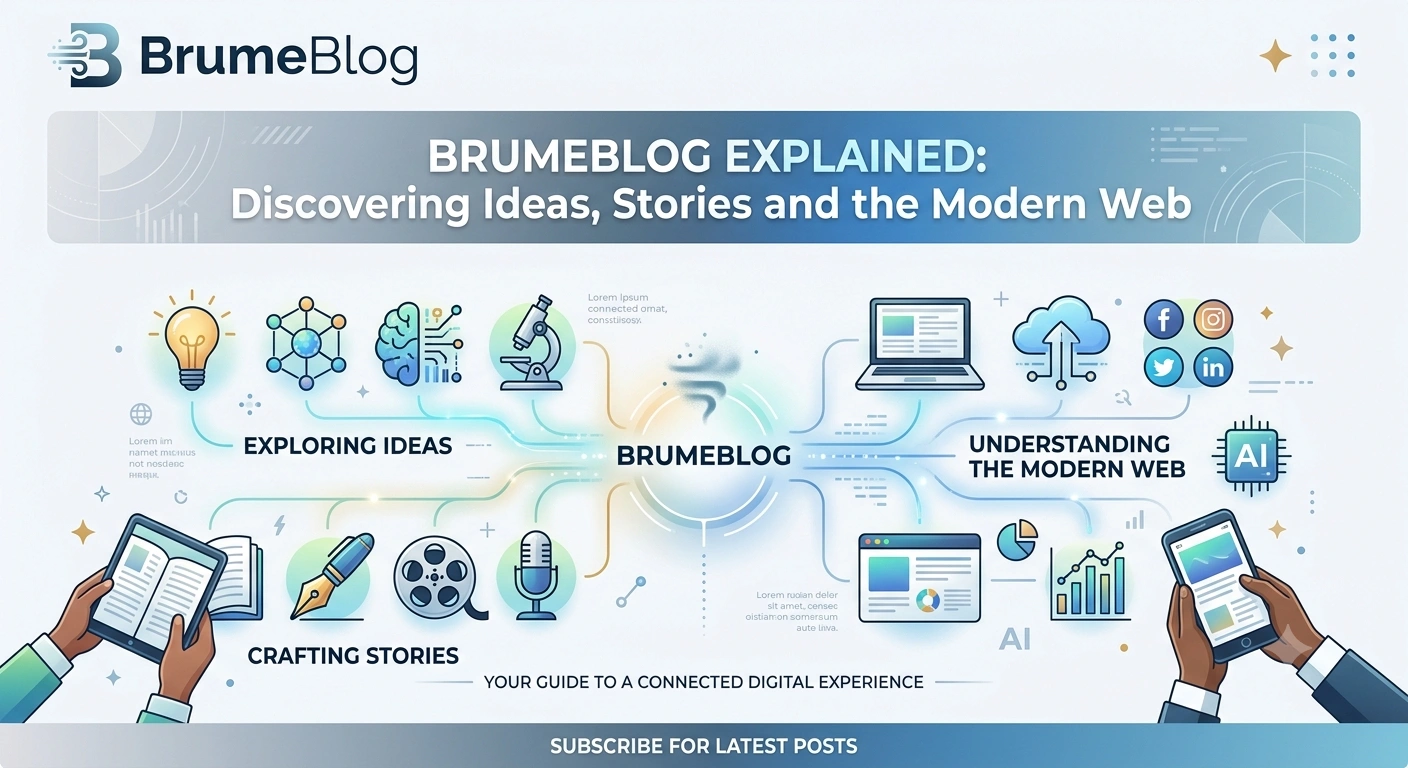
BrumeBlog Explained: Discovering Ideas, Stories and the Modern Web.
Introduction
The internet has transformed the way people discover ideas, information, opinions, and practical advice.
A question that once required a newspaper, magazine, or reference book can now be answered within seconds. Search engines, social platforms, newsletters, blogs, and AI-powered tools have created an enormous digital information ecosystem.
Within this environment, names such as BrumeBlog represent the broader evolution of online publishing: creating accessible content that readers can discover, scan, understand, and share.
But building a useful digital publication involves more than simply publishing articles.
Modern readers expect content to be clear, relevant, accurate, original, and easy to navigate. Search engines and AI systems increasingly evaluate content in ways that also reward usefulness and credibility.
This guide explores BrumeBlog, the modern blogging environment, what makes online content valuable, and how publishers can approach SEO, AEO, GEO, and E-E-A-T to create a stronger digital presence.
What Is BrumeBlog?
BrumeBlog is a digital publishing concept centered around online articles, ideas, information, and reader-focused content.
The name “BrumeBlog” combines a distinctive brand identity with the familiar concept of a blog.
A blog can cover almost any subject, depending on its editorial direction.
Potential areas include:
- Technology
- Lifestyle
- Business
- Entertainment
- Digital trends
- Productivity
- Travel
- Education
- Online culture
- Everyday advice
The flexibility of a blog allows a publication to develop its own voice while building topical authority over time.
Why Digital Blogs Continue to Matter
Some people predicted that social media and short-form video would make traditional blogging irrelevant.
Instead, blogs have continued to play an important role in online discovery.
Why?
Because social posts are often designed for quick consumption, while articles can provide:
- Detailed explanations
- Step-by-step guides
- Background information
- Comparisons
- Research
- Context
- Frequently asked questions
A useful article can remain discoverable long after a social media post disappears from a user’s feed.
The Evolution of the Modern Blog
Early blogs were often personal online diaries.
Modern blogs can be much more sophisticated.
Today, a digital publication may operate as:
Blog → Information hub → Topic authority → Search resource → Brand
This evolution means publishers need to think about both content and the overall reader experience.
What Makes a Good BrumeBlog Article?
A strong article should answer a clear reader need.
Several elements can make an article more useful.
Clear Purpose
The reader should immediately understand what the article covers.
Helpful Introduction
The opening should explain the topic without unnecessary filler.
Logical Structure
H2 and H3 headings should organize information naturally.
Direct Answers
Important questions should receive clear, concise answers.
Useful Examples
Examples help readers understand abstract concepts.
Accurate Information
Important claims should be checked against reliable sources.
The Importance of Reader Intent
Before writing an article, publishers should ask:
What does the reader actually want to know?
For example, someone searching:
“What is BrumeBlog?”
probably wants a definition.
Someone searching:
“BrumeBlog articles”
may want to find content.
Someone searching:
“BrumeBlog reviews”
may be evaluating the platform.
Someone searching:
“best blogs for digital trends”
is likely comparing several resources.
These are different search intents and require different content approaches.
Understanding SEO for BrumeBlog
Search Engine Optimization (SEO) helps content become discoverable through search engines.
But modern SEO is much more than adding keywords.
A strong SEO strategy considers:
- Search intent
- Content quality
- Topic relevance
- Site structure
- Internal linking
- Page experience
- Originality
- Trustworthiness
Keywords are useful signals, but they should naturally support the subject rather than interrupt the reader’s experience.
Why Keyword Stuffing Doesn’t Work Well
Consider an article that repeats:
“BrumeBlog is a blog. BrumeBlog articles are BrumeBlog content. Visit BrumeBlog for BrumeBlog information.”
The keyword may appear frequently, but the writing is unnatural.
A better approach is to use related terms naturally:
- BrumeBlog
- online publication
- digital content
- articles
- blogging platform
- web publishing
The goal is topical clarity, not repetition.
BrumeBlog and Answer Engine Optimization
Answer Engine Optimization, or AEO, focuses on making information easy for answer engines to understand and retrieve.
AEO-friendly content often uses:
- Direct definitions
- Question-based headings
- Short answers
- Lists
- Tables
- FAQs
- Clearly structured explanations
For example:
What is BrumeBlog?
BrumeBlog can be presented as a digital publishing concept focused on accessible online articles, ideas, and general-interest information.
The rest of the article can then provide additional context.
BrumeBlog and Generative Engine Optimization
GEO stands for Generative Engine Optimization.
As AI assistants increasingly influence how people discover information, content needs to be understandable to both humans and AI systems.
GEO-friendly content benefits from:
- Clear terminology
- Well-defined topics
- Accurate information
- Logical organization
- Supporting evidence
- Context
- Author transparency
The goal is not simply to “write for AI.”
The goal is to make information easy for systems to interpret while maintaining a high-quality human reading experience.
Why E-E-A-T Matters
E-E-A-T stands for:
- Experience
- Expertise
- Authoritativeness
- Trustworthiness
These concepts are especially valuable for digital publishers.
Readers want to know:
Who created this content?
Does the writer understand the subject?
Can the information be trusted?
Is the article current?
A publication can strengthen these signals through transparent editorial practices.
Author Profiles Build Credibility
An author page can provide useful information such as:
- Author name
- Professional background
- Areas of expertise
- Relevant experience
- Published articles
- Editorial responsibilities
For specialized subjects, expert involvement can make content considerably more useful.
For example, technology articles can benefit from knowledgeable technology professionals, while financial content may require qualified financial expertise.
Original Experience Makes Content More Valuable
The web already contains enormous amounts of generic information.
This makes original experiences increasingly valuable.
A publisher can differentiate its content through:
First-Hand Testing
Test a tool, product, or process and explain what happened.
Original Research
Collect information that isn’t simply copied from another website.
Interviews
Include perspectives from people with relevant expertise.
Case Studies
Show how an idea works in a real situation.
Data Analysis
Turn raw information into useful conclusions.
These approaches give readers something beyond a basic summary.
Why Context Matters
A fact without context can be difficult to understand.
For example:
“AI usage is increasing.”
This statement alone tells readers very little.
A useful article might explain:
- Where AI adoption is increasing
- What businesses are using it for
- What benefits organizations report
- What limitations exist
- How workers are adapting
Context transforms a statement into useful information.
BrumeBlog and Mobile-First Reading
Modern readers often access content from smartphones.
This makes mobile usability essential.
A reader-friendly blog should consider:
- Responsive layouts
- Readable typography
- Short paragraphs
- Clear headings
- Fast-loading pages
- Easy navigation
- Limited intrusive elements
If readers struggle to navigate a page, even excellent content may fail to deliver its value.
Why Visual Content Can Improve Articles
Text isn’t always the best way to explain something.
Depending on the topic, publishers can use:
- Infographics
- Charts
- Diagrams
- Screenshots
- Original illustrations
- Photographs
- Videos
Visual elements can help explain complex ideas and make long articles easier to scan.
The important principle is relevance.
A visual should add information or clarity rather than simply fill space.
Building Topic Clusters
A strong blog shouldn’t be a random collection of unrelated articles.
Instead, publishers can organize content into topic clusters.
For example:
Technology
- Artificial intelligence
- Software
- Apps
- Cybersecurity
- Gadgets
Digital Lifestyle
- Productivity
- Online tools
- Social media
- Digital organization
Business
- Entrepreneurship
- Marketing
- Small business
- Workplace technology
Each major topic can have a central guide supported by more specific articles.
Why Internal Linking Matters
Internal links connect related articles.
Suppose a reader starts with:
AI Productivity Tools
They could then explore:
AI Automation → Digital Workflows → Productivity → Time Management
This creates a natural information journey.
Internal linking can also help search engines understand relationships between pages.
Content Freshness Is Important
Not every article needs frequent updates.
Evergreen subjects may remain useful for years.
However, time-sensitive subjects can change quickly.
Examples include:
- Software
- AI tools
- Technology
- Pricing
- Social platforms
- Product specifications
- Online services
For these subjects, publishers should review content periodically.
Why Publication Dates Matter
Readers should be able to determine whether information is current.
A useful article can display:
Published: August 2026
Updated: August 2026
For information that changes frequently, an update date can provide valuable context.
It also encourages publishers to treat their content library as something that requires maintenance.
Artificial Intelligence and the Future of Blogging
AI has changed online publishing in two major ways.
First, AI can help writers create content more efficiently.
Second, AI is changing how readers discover content.
Writers can use AI for:
- Brainstorming
- Outlining
- Research organization
- Editing assistance
- Summarization
- Data organization
However, AI-generated information still requires human verification.
Human Oversight Remains Essential
AI can sometimes produce:
- Incorrect facts
- Outdated information
- Unsupported claims
- Fabricated references
- Repetitive writing
A responsible editorial workflow should therefore include:
Research → Draft → Verify → Edit → Fact-check → Publish → Review
AI can support the process.
It should not eliminate editorial judgment.
How BrumeBlog Can Build a Stronger Content Strategy
A modern digital publication can focus on several core principles.
1. Identify Real Questions
Start with problems readers actually search for.
2. Build Topic Depth
Create multiple useful articles around related subjects.
3. Add Original Value
Provide experiences, examples, data, or insights.
4. Make Authors Visible
Show readers who created the content.
5. Keep Important Articles Updated
Review information when circumstances change.
6. Improve Internal Linking
Connect related content naturally.
7. Use Structured Content
FAQs, tables, lists, and definitions can improve usability.
The Difference Between Short and Valuable Content
A common misconception is that useful online content must be extremely short.
That’s not always true.
A 400-word article can fully answer a simple question.
A detailed guide may legitimately require 2,000 words or more.
The right length depends on the topic.
The priority should be:
Completeness without unnecessary repetition.
How Readers Can Evaluate an Online Blog
Readers should not automatically trust every article they find online.
Before relying on information, consider:
1. Who wrote it?
Look for an identifiable author.
2. When was it published?
Check whether the information could be outdated.
3. What evidence is provided?
Important claims should have appropriate support.
4. What is the purpose?
Determine whether the article is informational, promotional, or opinion-based.
5. Can important claims be verified?
Compare significant information with reliable independent sources.
Special Care for Health and Financial Content
Some topics carry greater consequences than others.
Health information should ideally reference reputable medical organizations and qualified professionals.
Financial information should be checked against authoritative financial institutions, regulators, or qualified professionals.
A general-interest blog should clearly distinguish educational information from personalized professional advice.
The Role of Transparency in Publishing
Trust can be strengthened when a publication clearly explains:
- Who operates the website
- Who writes articles
- How content is reviewed
- How corrections are handled
- How sponsored content is identified
- How readers can contact the publication
Transparency gives readers additional context when evaluating information.
What the Future of Digital Publishing Looks Like
Online publishing is becoming increasingly diverse.
People now discover information through:
- Search engines
- AI assistants
- Social media
- Video platforms
- News applications
- Email newsletters
- Online communities
This means publishers need to create content that works across multiple discovery environments.
An article should be:
Searchable + readable + useful + trustworthy.
Why BrumeBlog-Type Content Can Still Stand Out
The internet has never had more content.
At the same time, there has never been more competition for reader attention.
This creates an interesting paradox:
More information does not automatically mean better information.
A publication can stand out by offering:
- Better explanations
- Original experiences
- Stronger research
- Expert perspectives
- Useful examples
- Updated information
- Clear writing
The objective should not simply be to publish more pages.
It should be to publish pages worth reading.
A Practical Content Quality Checklist
Before publishing an article, ask:
- Is the topic clearly defined?
- Does the introduction answer the basic question?
- Is the information accurate?
- Are important claims supported?
- Is the article original?
- Does it satisfy search intent?
- Are headings useful?
- Can readers scan it easily?
- Are related articles linked?
- Is the author identifiable?
- Is the information current?
- Does the article provide genuine value?
If several answers are “no,” the article probably needs another editorial pass.
Frequently Asked Questions
What is BrumeBlog?
BrumeBlog can be described as a digital publishing concept centered around online articles, ideas, information, and reader-focused content.
What type of content can BrumeBlog cover?
A flexible digital publication can cover subjects such as technology, lifestyle, business, entertainment, productivity, digital trends, and other general-interest topics depending on its editorial strategy.
Why is SEO important for BrumeBlog?
SEO helps users discover online content through search engines. Effective SEO focuses on search intent, useful information, clear structure, technical accessibility, and content quality.
What is AEO?
AEO stands for Answer Engine Optimization. It involves structuring information so that direct questions and answers are easy for search engines and answer systems to understand.
What does GEO mean?
GEO stands for Generative Engine Optimization. It focuses on creating clear, authoritative, well-structured information that can be understood by AI-powered search and answer systems.
Why is E-E-A-T important?
E-E-A-T stands for Experience, Expertise, Authoritativeness, and Trustworthiness. These qualities can help readers assess whether online content is credible and useful.
How can a blog build authority?
A blog can build authority by publishing original research, demonstrating expertise, maintaining accurate information, identifying authors, citing reliable sources, and developing comprehensive topic coverage.
Should blog articles be updated?
Time-sensitive articles should be reviewed when important information changes. Evergreen content may need less frequent updates, but it should still be checked periodically for accuracy.
BrumeBlog Content Strategy at a Glance
| Area | Recommended Approach |
|---|---|
| SEO | Focus on search intent and useful content |
| AEO | Provide direct answers and FAQs |
| GEO | Use clear entities, context, and evidence |
| E-E-A-T | Show expertise, authorship, and sources |
| Content | Prioritize originality and usefulness |
| Structure | Use headings, lists, tables, and short paragraphs |
| Internal Linking | Connect related articles |
| Updates | Review time-sensitive information |
| Visuals | Use relevant original graphics |
| Mobile | Prioritize readability and usability |
Conclusion
BrumeBlog represents the broader opportunity available to modern digital publishers: turning online information into content that is easy to discover, understand, and trust.
The internet has made publishing easier than ever.
But easy publishing has also created enormous competition.
There are now countless articles competing for the same reader, and artificial intelligence has made the production of generic content even faster.
That makes quality more important—not less.
A strong publication should focus on the fundamentals:
- Answer real questions
- Write clearly
- Provide useful context
- Verify important information
- Show who created the content
- Add original insights
- Keep important pages updated
- Build logical topic clusters
- Create a strong reader experience
SEO can help people find content.
AEO can make answers easier to retrieve.
GEO can make information easier for AI systems to understand.
E-E-A-T can help establish credibility.
But the foundation remains the same:
Create something genuinely useful for the person reading it.
As digital discovery continues moving across search engines, social networks, video platforms, and AI assistants, publishers will need to think beyond traditional rankings.
The most valuable content will be content that gives readers a reason to stay.
Sometimes that means explaining a complicated idea simply.
Sometimes it means providing original research.
Sometimes it means sharing a first-hand experience.
And sometimes it simply means answering a question better than the alternatives.
For BrumeBlog and similar digital publishing brands, the long-term opportunity is not just to become another website filled with articles.
It is to become a reliable destination for useful information and ideas.
The future of blogging won’t necessarily belong to the publishers who produce the most content.
It will belong to those who consistently produce content that readers can find, understand, verify, and use.