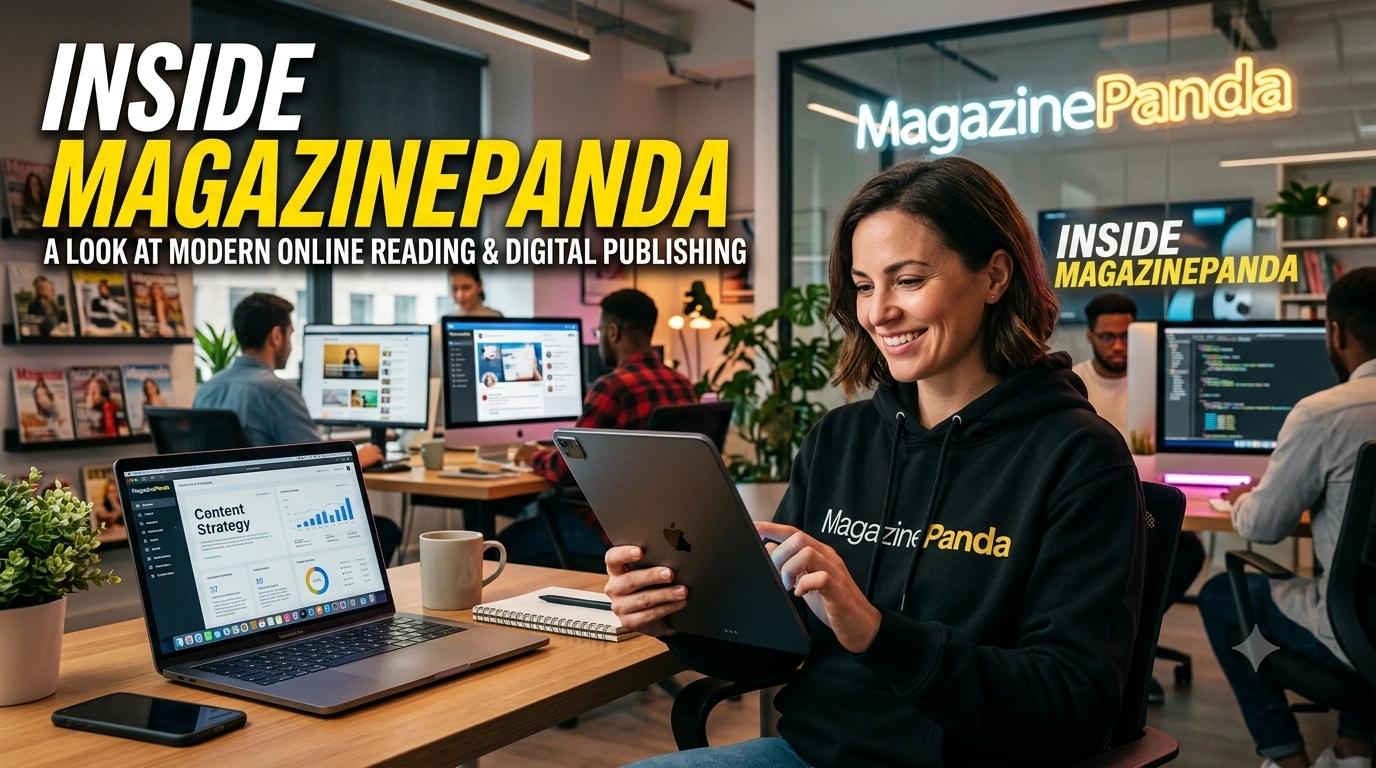
Inside MagazinePanda: A Look at Modern Online Reading and Digital Publishing.
Introduction
The way people consume magazines and articles has changed dramatically.
Instead of waiting for a printed issue, readers can now open a phone, tablet, or computer and access thousands of articles within seconds. Digital magazines combine the familiarity of traditional publishing with the flexibility of the internet, allowing information to be updated, shared, searched, and consumed from almost anywhere.
MagazinePanda fits into this broader digital publishing environment, presenting itself as an online platform focused on articles, blogs, insights, and content across multiple areas. Its currently accessible website describes a broad content approach that includes subjects ranging from lifestyle to technology, along with analyses, reviews, and other reader-focused material.
But what makes an online magazine useful today?
It is not simply the number of articles available.
Modern readers increasingly look for clear explanations, useful information, engaging writing, easy navigation, trustworthy sources, and content that helps them understand a subject quickly.
This guide explores MagazinePanda, the changing role of online magazines, digital content strategy, reader experience, SEO, AEO, GEO, and the qualities that can help an online publication become a useful destination for readers.
What Is MagazinePanda?
MagazinePanda is an online publishing and digital-content brand built around articles and blogs covering a range of subjects.
The currently accessible MagazinePanda website describes its content as spanning areas such as lifestyle and technology, while also highlighting analyses, reviews, and general-interest articles.
This places MagazinePanda within the broad category of multi-topic digital publishing platforms.
Unlike a specialist publication that focuses exclusively on one subject, a general-interest platform can cover several categories.
Potential areas include:
- Technology
- Lifestyle
- Business
- Education
- Entertainment
- Productivity
- Digital trends
- Travel
- Health and wellness
- Online culture
The exact categories and publishing focus can evolve as a publication develops.
How Online Magazines Have Changed
Traditional magazines were usually organized around scheduled editions.
A reader might purchase:
- A weekly issue
- A monthly magazine
- A special edition
- A seasonal publication
Digital magazines operate differently.
An online article can be:
- Published immediately
- Updated later
- Shared through social media
- Discovered through search engines
- Connected to related articles
- Enhanced with video and interactive media
This flexibility has changed the definition of a magazine.
A modern digital magazine can function more like a constantly evolving information library.
Why Digital Publishing Remains Important
The growth of social media and video has not eliminated written content.
Instead, different formats now work together.
A reader might:
See a video → Search for more information → Read an article → Compare sources → Share the information
Written articles remain particularly useful when readers need detailed explanations.
They can provide context that is difficult to communicate in a short social post.
MagazinePanda and Diverse Content
One of the defining characteristics of a general-interest publication is topic variety.
MagazinePanda’s accessible website emphasizes diverse content and describes its goal as delivering articles that inform and inspire readers.
A broad editorial strategy can benefit readers because they can explore different subjects without visiting multiple specialized websites.
For example, one reader may arrive for a technology article and later discover content about:
- Productivity
- Lifestyle
- Business
- Digital culture
This creates opportunities for content discovery beyond the original search query.
The Value of Topic Diversity
A broad content library can serve different reader interests.
However, variety should not mean publishing unrelated information without structure.
A successful multi-topic publication needs organization.
Useful categories, tags, topic pages, and internal links can help readers move through the site naturally.
For example:
Technology
- AI
- Apps
- Software
- Gadgets
- Digital tools
Lifestyle
- Everyday habits
- Home
- Travel
- Wellness
- Personal interests
Business
- Entrepreneurship
- Marketing
- Productivity
- Workplace trends
The objective is to create a library rather than a random collection of pages.
What Makes an Online Article Valuable?
A reader does not visit an article simply because it exists.
The article needs to solve an information need.
A useful article should generally provide:
A Clear Answer
The reader should understand the basic answer quickly.
Supporting Context
Additional information should explain why the answer matters.
Practical Examples
Examples make unfamiliar concepts easier to understand.
Reliable Information
Important claims should be checked.
Easy Navigation
Readers should be able to scan the article comfortably.
MagazinePanda and Reader Experience
A modern online publication needs to consider the complete reader journey.
The experience begins before the article.
A reader may discover a page through:
- Social media
- AI search
- A shared link
- A newsletter
- Another website
After arriving, the reader needs to find the information without unnecessary friction.
A good experience includes:
- Clear headlines
- Helpful introductions
- Logical headings
- Readable paragraphs
- Relevant images
- Simple navigation
- Related articles
Why Mobile Reading Matters
Many people access online content from smartphones.
That makes mobile-friendly design an essential part of digital publishing.
A good mobile article should have:
- Readable text
- Responsive design
- Comfortable spacing
- Easy-to-use menus
- Fast loading
- Clear buttons
- Minimal intrusive elements
Even excellent writing can lose its value if readers cannot comfortably access it.
MagazinePanda and Search Engine Optimization
Search engines remain one of the most important discovery channels for online content.
SEO, or Search Engine Optimization, helps search engines understand and surface relevant pages.
For a digital magazine, effective SEO involves more than inserting keywords.
Important considerations include:
- Search intent
- Content quality
- Topic relevance
- Internal linking
- Page structure
- Technical performance
- Originality
- Trust signals
The strongest approach is to create content for people first while making the information easy for search systems to understand.
Search Intent Comes First
Every search represents an underlying purpose.
For example:
“What is MagazinePanda?”
This is primarily informational.
“MagazinePanda website”
This may indicate navigational intent.
“MagazinePanda articles”
This suggests the user wants to explore content.
“Best online magazines”
This is more comparative.
Understanding the intent helps publishers create the appropriate page.
MagazinePanda and AEO
AEO stands for Answer Engine Optimization.
It focuses on structuring content so that direct answers are easier for search and answer systems to identify.
AEO-friendly articles often include:
- Direct definitions
- Question-based headings
- Short answers
- Lists
- Tables
- FAQs
- Clear explanations
For example:
What is MagazinePanda?
MagazinePanda is an online digital publishing brand focused on articles, blogs, and broad-interest content.
A direct answer like this gives readers immediate context before the article moves into deeper information.
MagazinePanda and GEO
GEO stands for Generative Engine Optimization.
As AI-powered search and answer systems become more important, content publishers need to make information easy for AI systems to interpret.
Useful GEO practices include:
- Clearly defining entities
- Using consistent terminology
- Providing context
- Organizing information logically
- Supporting important claims
- Identifying authors
- Maintaining current information
The goal is not to manipulate AI systems.
The goal is to create information that is understandable, useful, and trustworthy.
Why E-E-A-T Matters for Digital Magazines
E-E-A-T represents:
- Experience
- Expertise
- Authoritativeness
- Trustworthiness
These concepts can help readers determine whether content deserves their attention.
An online publication can strengthen these signals by providing:
- Author biographies
- Editorial policies
- Reliable references
- Publication dates
- Update dates
- Correction policies
- Transparent contact information
Trust is especially important when content covers subjects that can affect important decisions.
Author Transparency
A clear author profile can answer several reader questions.
Who wrote this?
What experience do they have?
Why should I trust their explanation?
For specialist topics, author expertise becomes even more important.
Technology articles can benefit from technology professionals.
Financial content should be reviewed carefully and should rely on authoritative financial information.
Health-related content should be handled with appropriate professional and medical sources.
The Difference Between Information and Opinion
Online magazines can contain many types of content.
Readers should be able to distinguish between:
- News
- Analysis
- Opinion
- Reviews
- Tutorials
- Sponsored content
- Educational articles
Clear labeling improves transparency.
A personal opinion should not be presented as an established fact.
Similarly, promotional material should be distinguishable from independent editorial content.
Why Originality Matters
The internet already contains millions of articles.
Simply rewriting information that already exists may provide little additional value.
A stronger publication can differentiate itself through:
Original Research
Collect and analyze information.
First-Hand Experience
Explain what happened when a product, tool, or process was actually tested.
Expert Interviews
Bring perspectives from knowledgeable people.
Case Studies
Show how an idea works in practice.
Unique Examples
Explain concepts using situations readers can relate to.
Originality gives readers a reason to choose one article over another.
MagazinePanda and Content Clusters
A publication can build stronger topical coverage through content clusters.
Imagine a central topic such as:
Digital Technology
Supporting articles could cover:
- AI tools
- Digital productivity
- Online privacy
- Mobile applications
- Software trends
- Technology for small businesses
Each article can link to related pages.
This creates a connected knowledge network.
Why Internal Linking Helps
Internal links guide readers from one useful page to another.
For example:
AI Tools
↓
AI Productivity
↓
Digital Workflows
↓
Time Management
This approach helps readers continue learning instead of ending their session after one article.
It also gives search engines additional information about relationships between pages.
Evergreen Content vs. Trending Content
A strong digital magazine can combine two types of articles.
Trending Content
Designed around subjects currently receiving attention.
Examples:
- New technology launches
- Major digital trends
- Current online discussions
- Emerging tools
Evergreen Content
Designed to remain useful over time.
Examples:
- Beginner guides
- Definitions
- Tutorials
- How-to articles
- Explanations
A healthy content strategy can use both.
Trending content attracts timely interest.
Evergreen content creates long-term usefulness.
Why Content Updates Matter
Digital information changes quickly.
This is especially true for:
- Technology
- Software
- AI
- Online services
- Product specifications
- Pricing
- Social media platforms
An article that was accurate two years ago may contain outdated information today.
Publishers should therefore review important pages periodically.
What an Updated Article Should Include
When information changes, an article can be reviewed for:
- Outdated statistics
- Broken links
- Old screenshots
- Incorrect product information
- Changed features
- New developments
- Missing context
Adding a visible Updated date can also help readers understand the freshness of the information.
MagazinePanda and Visual Storytelling
Articles don’t need to rely exclusively on paragraphs.
Relevant visuals can improve understanding.
Useful formats include:
- Infographics
- Charts
- Diagrams
- Screenshots
- Original illustrations
- Videos
- Photographs
For example, a comparison article may be easier to understand as a table.
A complicated process may be clearer as a diagram.
The format should match the information.
Social Media and Digital Publishing
Social media can act as a distribution channel for online articles.
A single article can be adapted into:
| Content Format | Primary Purpose |
|---|---|
| Full Article | Detailed information |
| Short Post | Quick takeaway |
| Video | Visual explanation |
| Infographic | Simplified data |
| Newsletter | Curated discovery |
| FAQ | Direct answers |
This approach allows publishers to extend the life of an idea beyond the original article.
AI and the Future of Magazine Publishing
Artificial intelligence is changing both content creation and content discovery.
Writers can use AI-assisted tools for:
- Brainstorming
- Outlining
- Research organization
- Editing
- Summarization
- Translation
- Content repurposing
However, AI-generated content should not automatically be treated as accurate.
Human review remains essential.
Why Human Editorial Judgment Still Matters
AI systems can sometimes produce:
- Incorrect facts
- Outdated information
- Missing context
- Unsupported claims
- Repetitive explanations
A responsible workflow is therefore:
Research → Draft → Verify → Edit → Fact-check → Publish → Update
AI can make certain tasks more efficient.
Human judgment determines whether the final article is actually useful.
How to Build Trust With Readers
Trust develops over time.
An online publication can strengthen reader confidence by:
Being Transparent
Clearly explain who operates the publication.
Showing Authors
Give writers visible profiles.
Citing Reliable Sources
Link important claims to appropriate evidence.
Correcting Errors
Update meaningful mistakes rather than hiding them.
Separating Advertising
Clearly distinguish sponsored material from editorial content.
Keeping Information Current
Review important articles regularly.
How Readers Can Evaluate MagazinePanda Articles
Readers should evaluate individual articles rather than assuming that every page on any website has the same level of authority.
Before relying on information, ask:
Who wrote the article?
Look for an identifiable author.
When was it published?
Check whether the information may have become outdated.
Are sources provided?
Important factual claims should have appropriate support.
What type of article is it?
Determine whether it is educational, analytical, promotional, or opinion-based.
Can important claims be verified?
For significant subjects, compare information with authoritative sources.
MagazinePanda for General Information
A broad digital magazine can be particularly useful for discovery.
Readers may use it to:
- Learn about unfamiliar subjects
- Discover new ideas
- Explore trends
- Find practical tips
- Compare perspectives
- Identify subjects for deeper research
For highly consequential subjects, however, readers should go beyond a single general-interest article.
This is especially important for:
- Medical decisions
- Financial decisions
- Legal questions
- Safety issues
- Security concerns
Building a Better MagazinePanda Content Strategy
A strong publishing strategy can follow a repeatable process.
Step 1: Understand the Audience
Identify who the content is intended to help.
Step 2: Research Search Intent
Determine what readers actually want to know.
Step 3: Choose the Right Format
Decide whether the topic needs an article, guide, comparison, FAQ, or visual explanation.
Step 4: Research Carefully
Use reliable sources and primary information where possible.
Step 5: Create a Clear Structure
Use descriptive headings and logical sections.
Step 6: Add Original Value
Provide examples, experience, analysis, or useful context.
Step 7: Fact-Check
Verify important claims before publication.
Step 8: Optimize for Discovery
Use appropriate SEO, AEO, and GEO practices.
Step 9: Publish
Make the article accessible across desktop and mobile.
Step 10: Review and Update
Improve the article when information changes.
MagazinePanda Content Quality Checklist
Before publishing an article, ask:
- Does the article answer a real question?
- Is the main topic clear?
- Does the introduction provide immediate value?
- Are the facts accurate?
- Are important claims supported?
- Is the writing original?
- Does the structure make sense?
- Are headings descriptive?
- Is the page easy to read on mobile?
- Are relevant internal links included?
- Is the author identified?
- Is the publication date visible?
- Does the article need an update?
- Does the conclusion provide a useful takeaway?
This checklist can help turn ordinary articles into stronger resources.
The Future of Online Magazine Platforms
Digital publishing will continue to evolve.
Readers now have more ways than ever to discover information:
- Search engines
- Social networks
- Video platforms
- AI assistants
- News applications
- Email newsletters
- Online communities
This creates both opportunities and challenges for publishers.
A publication cannot rely on one traffic source forever.
Instead, it should build content that remains useful wherever readers discover it.
What Makes a Digital Magazine Stand Out?
The biggest advantage is not necessarily publishing more frequently.
It is providing something readers value.
That might be:
Better explanations.
Original research.
Useful examples.
Clear comparisons.
Expert perspectives.
Timely updates.
Simple answers to complicated questions.
The strongest publications understand that readers are not looking for more information.
They are looking for better information.
Frequently Asked Questions
What is MagazinePanda?
MagazinePanda is an online digital publishing brand focused on articles, blogs, and broad-interest content. Its accessible website describes content spanning areas such as lifestyle and technology.
What topics does MagazinePanda cover?
The platform presents itself as a multi-topic publication, with content and services described around areas including technology, lifestyle, analyses, reviews, and general-interest information.
Is MagazinePanda an online magazine?
MagazinePanda can be viewed as part of the modern online-magazine and digital-publishing ecosystem, where readers access articles and blogs through the web rather than through traditional printed editions.
Why are digital magazines popular?
Digital magazines are convenient because readers can access content from phones, tablets, and computers. They can also publish and update articles more quickly than traditional print publications.
How can readers evaluate an article on MagazinePanda?
Readers should check the author, publication date, sources, purpose, and evidence behind important claims. For high-stakes topics, information should be verified with authoritative sources.
What is the difference between SEO and AEO?
SEO focuses broadly on helping content become discoverable through search engines, while AEO focuses on structuring information so direct answers can be easily understood and surfaced by answer systems.
What does GEO mean in digital publishing?
GEO, or Generative Engine Optimization, focuses on making content clear, contextual, well-structured, and trustworthy so that AI-powered search and answer systems can interpret it accurately.
Should MagazinePanda articles be updated?
Articles covering changing subjects such as technology, software, AI, pricing, and online services should be reviewed periodically to ensure that important information remains current.
MagazinePanda at a Glance
| Area | Key Takeaway |
|---|---|
| Platform Type | Digital publishing / online magazine |
| Content Style | Articles, blogs, insights and reviews |
| Topic Range | Broad and multi-topic |
| Reader Goal | Information and discovery |
| SEO Focus | Search intent and useful content |
| AEO Focus | Direct answers and structured information |
| GEO Focus | Clear, contextual information for AI systems |
| E-E-A-T | Authors, evidence, transparency and accuracy |
| Content Strategy | Evergreen + timely topics |
| Growth Strategy | Quality, topical depth and reader trust |
Conclusion
MagazinePanda represents the changing nature of online magazine publishing, where readers can explore ideas, articles, insights, and practical information without depending on a traditional printed publication.
The accessible MagazinePanda website emphasizes diverse content, including lifestyle and technology, while also highlighting analyses, reviews, and reader-focused material.
But the future of digital publishing is about more than simply having a large collection of articles.
Readers increasingly expect content to be:
- Useful
- Accurate
- Easy to understand
- Well organized
- Current
- Transparent
- Worth their time
SEO can help people discover an article.
AEO can make its answers easier to identify.
GEO can help information become understandable to AI-powered discovery systems.
E-E-A-T can help establish credibility.
Yet none of these replace the most important principle of publishing:
Give the reader genuine value.
A strong digital magazine should help people discover information, understand unfamiliar subjects, explore new perspectives, and make better-informed decisions.
As the boundaries between magazines, blogs, search engines, social media, and AI assistants continue to disappear, online publishers have an opportunity to become more than content libraries.
They can become trusted information destinations.
For MagazinePanda and similar platforms, that means focusing on the fundamentals: useful topics, clear writing, original value, responsible sourcing, strong organization, and an excellent reader experience.
The internet will continue to change.
The formats will change.
The discovery channels will change.
But the demand for useful information will remain.
And ultimately, the digital publications that succeed will be the ones that consistently give readers a reason to return.